
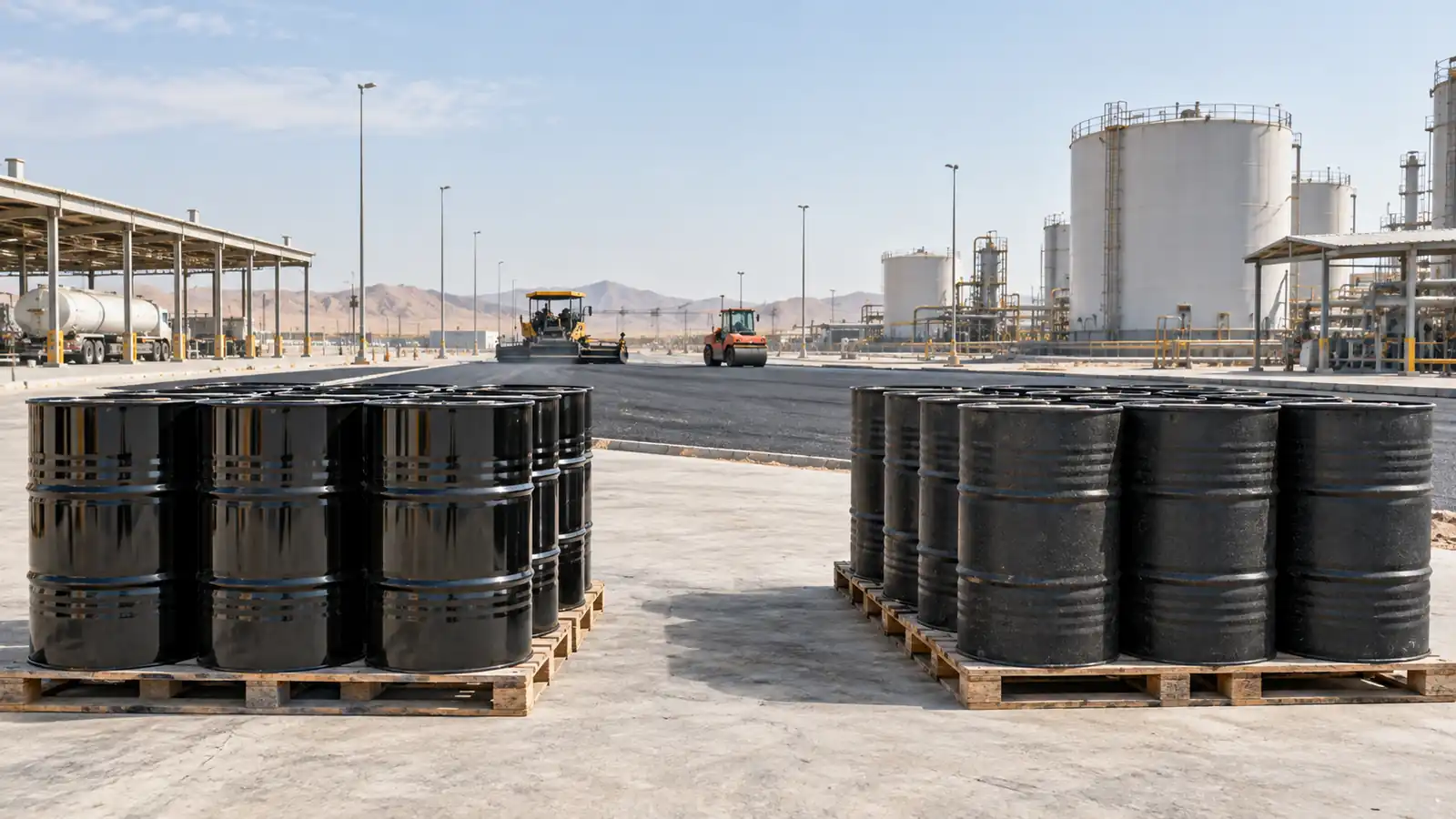
Why buyers compare Bitumen 40/50 and 60/70
Bitumen 40/50 and Bitumen 60/70 are penetration-grade paving binders frequently considered for asphalt roads, industrial pavements and infrastructure work. Buyers often compare them because both can appear in project specifications, yet they do not behave identically. The lower penetration range of 40/50 generally describes a harder binder under the stated test conditions, while 60/70 is comparatively softer. That distinction can influence resistance to deformation, workability and response to temperature, but it does not decide project suitability by itself.
The right grade must come from the approved pavement design, governing standard and qualified engineering review. Traffic loading, pavement temperature, aggregate structure, asphalt mix design, layer function, drainage and construction control all matter. This guide helps procurement teams ask better questions and compare offers on a consistent basis. It is not a substitute for a project specification, laboratory assessment or approval by the responsible road authority or engineer.
What the penetration numbers mean
Penetration is determined by measuring how far a standard needle enters a prepared bitumen sample under specified test conditions. The result is normally reported in tenths of a millimetre. A Bitumen 40/50 result falls within the defined 40-to-50 penetration range, while a Bitumen 60/70 result falls within the 60-to-70 range, subject to the applicable standard. A lower penetration number generally indicates a harder consistency at the test temperature; a higher number generally indicates a softer consistency.
Penetration alone is not a complete quality profile. Buyers should review the full contract specification, which may include softening point, ductility, viscosity, flash point, solubility, density, loss on heating and retained penetration after ageing. Test methods, units and acceptance tolerances must be stated. A grade name without a governing standard can create ambiguity, particularly when national specifications or project requirements add limits beyond the familiar penetration range.
The practical difference between 40/50 and 60/70
In broad terms, Bitumen 40/50 is the stiffer of the two grades. That stiffness may be considered where pavement temperatures are high, traffic is heavy or the mix needs stronger resistance to permanent deformation. Bitumen 60/70 offers greater softness and can provide a different balance between workability, flexibility and rutting resistance. These are general tendencies, not performance guarantees. The final asphalt behaviour depends on the complete mixture and the conditions in which it is produced and placed.
A hard binder is not automatically the premium choice, and a softer binder is not automatically easier or safer for every road. Excessive stiffness can contribute to cracking risk when pavement temperatures fall or the structure experiences movement. Insufficient stiffness can contribute to deformation under heat and slow, heavy traffic. Engineers manage these competing risks through binder selection, aggregate grading, volumetric design, layer thickness, compaction and quality control rather than through the penetration number alone.
Climate and pavement temperature
Climate is one of the first considerations in a Bitumen 40/50 versus 60/70 decision. Air temperature is useful, but pavement temperature is more relevant because dark asphalt surfaces can become considerably hotter under strong sunlight. Prolonged high pavement temperatures can soften the binder and increase susceptibility to wheel-path deformation when the mixture is not adequately designed. In such conditions, a project specification may consider a harder grade such as 40/50, a performance-graded binder or another engineered solution.
Cold nights, winter conditions, altitude and rapid temperature change also matter. A binder that becomes too stiff can make the pavement less able to accommodate thermal contraction or structural strain. Bitumen 60/70 may be considered where the approved design calls for more flexibility, but the correct response is project-specific. For work across Iraq and the Kurdistan Region, procurement teams should provide the precise project location rather than assuming one grade is suitable for every governorate, elevation or season.
Traffic, axle loads and pavement function
Heavy trucks, slow-moving traffic, frequent braking and concentrated wheel loads can place severe stress on asphalt. Industrial yards, port approaches, freight corridors and intersections may require a different binder-and-mixture strategy from a lightly trafficked municipal street. Bitumen 40/50 may be investigated for high-temperature, high-load service because of its greater stiffness, while 60/70 is widely requested for general paving applications. The authority-approved design must determine whether either grade is appropriate.
Layer function should also be identified. A wearing course, binder course and asphalt base operate under different stresses. The same binder choice cannot be assumed for every layer or every asphalt mix. The RFQ should name the layer, mixture designation, traffic category, approved specification and any additional performance criteria. Giving the supplier only the words road project is not enough to support a reliable technical or commercial response.
Workability, mixing and compaction
Binder consistency affects handling and asphalt production, but mixing and compaction temperatures should not be selected from a generic internet table. The approved job-mix formula, viscosity data, plant procedures and technical guidance should control. A harder binder may require careful temperature management to achieve coating and field density without unnecessary ageing. A softer binder can offer different handling characteristics, yet it still requires disciplined storage, dosing, mixing, transport and compaction.
Overheating does not correct a poor material choice or weak process control. Excessive temperature can accelerate oxidation and alter binder properties, while insufficient temperature can reduce coating or compaction quality. Buyers should ask how the product will be transported and stored, whether tanks and lines are clean, and how temperature records will be managed. The receiving asphalt plant should confirm that its equipment and procedures are suitable for the selected grade before delivery begins.
Specifications and quality documents
A commercial offer should identify Bitumen 40/50 or 60/70 together with the governing standard and agreed property limits. The supplier should not rely on a generic product label where the purchaser has issued a detailed specification. A technical data sheet can describe typical values, but shipment acceptance may require lot-specific evidence. The contract should explain which document controls, what test methods apply and how a result near an acceptance boundary will be treated.
A Certificate of Analysis should identify its original manufacturer or laboratory, the relevant batch or lot, test date, methods, units and measured results. Crude Link preserves the attribution of third-party and manufacturer documents rather than presenting them as its own laboratory work. Depending on the transaction, buyers may also request a certificate of origin, quantity or weight evidence, packing list, commercial invoice, safety information, inspection report and transport documents. Requirements should be agreed before quotation and loading.
Sampling, inspection and laboratory testing
Representative sampling connects the physical cargo to its reported test results. The inspection plan should state the sampling point, timing, lot represented, sealing method, sample custody, laboratory and test list. A sample taken from an unsuitable location may not fairly represent a tank, batch or shipment. Where quality acceptance is critical, the contract can provide for witnessed sampling, sealed duplicate samples and an agreed procedure for referee testing if the parties dispute a result.
Independent inspection can cover quantity, packing condition, markings, container loading, sampling and laboratory testing. The RFQ should identify the preferred inspection company or accreditation, the scope and who bears the cost. Photographs are useful for documenting visible condition, but they cannot establish penetration, softening point or other laboratory properties. Buyers should connect the COA, seals, lot references and inspection records so that the evidence forms a traceable chain.
Drums, jumbo bags and bulk delivery
Bitumen 40/50 and 60/70 may be discussed in steel drums, suitable jumbo-bag systems or bulk arrangements, subject to the product, route and receiving infrastructure. A packaged quotation should state net fill weight, packaging construction, pallet or frame arrangement, markings, container payload and the total net quantity. Comparing only the number of drums or bags can be misleading because tare weight and usable product per container affect freight economics.
The receiving method is as important as the packing price. Drums require unloading, storage, decanting and responsible handling of empty steel. Jumbo bags require compatible melting or release equipment and protection appropriate to the route and climate. Bulk supply requires heated, clean tanks, pumps, hoses and controlled discharge. Buyers can review these alternatives through Crude Link's bitumen packaging guide and should calculate total delivered and handling cost rather than choosing the lowest packing charge.
Pricing and quotation comparison
Neither grade has one permanent international price. A quotation depends on current product availability, specification, quantity, packaging, loading point, route, destination, shipment date, inspection, documents, payment structure and Incoterm. The price relationship between 40/50 and 60/70 can change with production conditions and demand. A historical indication or public market commentary is not an executable offer for a new project.
Compare suppliers using the same approved specification and commercial basis. Confirm the net metric tonnes, currency, named delivery point, included charges, validity, lead time, quantity tolerance and payment terms. Then include freight, insurance where applicable, customs, destination handling, storage, heating, unloading, packaging disposal and expected process losses. Crude Link's Iraq bitumen price guide explains these variables, while the FOB bitumen guide addresses export quotations at a named port.
A buyer checklist for choosing the grade
Begin with the approved project documents. Confirm the binder grade, standard, property limits, intended asphalt mixture, pavement layer, traffic class and climate assumptions. Ask the designer whether an alternative grade is permitted and what approval process applies. Then review the asphalt plant, storage and site handling capability. Procurement should not substitute 40/50 for 60/70, or the reverse, simply because one is cheaper or immediately available.
For supplier comparison, request the same information from every bidder: source description, governing specification, available quantity, packing, net weight, lot-specific quality evidence, inspection options, loading point, delivery basis, validity and lead time. Record all deviations from the RFQ. A technically compliant offer with clear documents and a practical route is more useful than a low headline price that does not match the approved material or project schedule.
How to request a 40/50 or 60/70 quotation
A complete inquiry should include the exact grade, full specification, intended application, net quantity, packaging preference, precise destination, requested Incoterm, target delivery or shipment window, inspection scope, document list and payment preference. State whether the requirement is a trial shipment, one-time project order or recurring programme. If the project team is still comparing grades, attach the technical requirements and ask for separate alternatives rather than allowing assumptions.
Crude Link Trading reviews qualified Bitumen 40/50 and Bitumen 60/70 inquiries for domestic and selected export markets, subject to availability and written confirmation. Buyers seeking 60/70 can also review the dedicated Bitumen 60/70 supplier page. For the wider product range, visit the main bitumen page, then use the RFQ form to submit the specification and commercial details. Final suitability, origin, quantity, packaging, price and delivery terms are established only in the applicable quotation and contract.
Frequently asked questions
Is Bitumen 40/50 harder than Bitumen 60/70?
Generally, yes. Under the defined penetration test, the lower 40/50 range indicates a harder consistency than 60/70. Project suitability still depends on the complete specification and pavement design.
Is Bitumen 40/50 always better for hot climates?
No. High temperature is important, but traffic, mixture design, pavement structure, layer function and project standards also control the selection. The responsible engineer or authority should approve the grade.
Can 60/70 be substituted for 40/50?
Not without technical approval. A change of grade can affect mixture behaviour and contract compliance, so any substitution should follow the project's formal review process.
What should a quotation request include?
Include the approved grade and standard, complete property limits, quantity, packaging, destination, Incoterm, schedule, inspection scope, required documents and payment preference.