
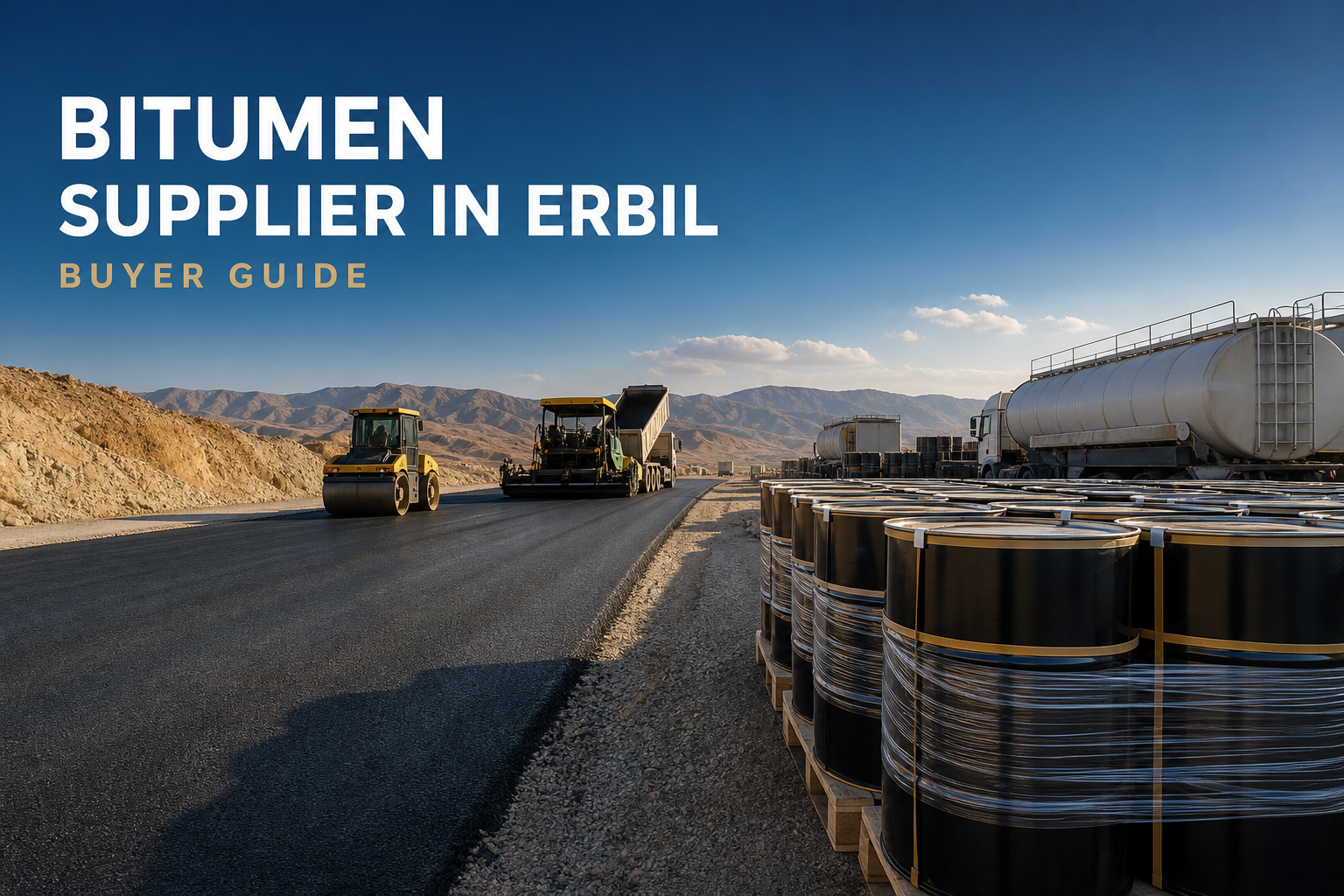
What Erbil bitumen buyers need from a supplier
A buyer searching for a bitumen supplier in Erbil is normally trying to solve a complete procurement problem, not simply locate a product name. The requirement may come from a road contractor, asphalt plant, infrastructure developer, distributor, waterproofing company, industrial user, or public-sector tender. Each buyer needs confidence that the proposed material can be evaluated against the approved specification, supplied in a practical package, supported by authentic documents, and delivered to the stated location within a workable schedule. A credible supplier therefore begins with questions about grade, standard, quantity, application, packaging, destination, timing, inspection, and commercial terms.
Crude Link Trading serves qualified inquiries for Erbil, the Kurdistan Region, and other Iraqi destinations from its registered office in Dubai. Service coverage should not be confused with a claim that every product or allocation is physically stocked in Erbil. Availability, producer, origin, loading point, specification, quantity, packaging, price, and route are confirmed in the transaction-specific quotation. This distinction gives buyers a more accurate basis for comparison and protects the integrity of manufacturer, laboratory, inspection, and transport documents.
Bitumen 50/70 and 60/70 for road projects
Bitumen 50/70 and Bitumen 60/70 are among the penetration grades frequently requested for asphalt paving and related construction work. The grade numbers refer to a penetration range measured under defined laboratory conditions. In general terms, 50/70 is harder than 60/70, but that comparison alone does not determine which material is suitable for a project. Engineers must consider the governing specification, expected pavement temperatures, traffic loading, asphalt-mixture design, aggregate structure, pavement layer, construction method, and authority approval.
Procurement teams should request the complete technical profile rather than accepting a grade label on its own. Penetration, softening point, ductility, viscosity, flash point, solubility, density or specific gravity, heating loss, and retained penetration may all be relevant, depending on the governing standard. Test methods, units, temperatures, minimums, maximums, sample identity, and document issuer need to be stated clearly. Crude Link can review inquiries for 50/70, 60/70, and other grades, but final conformity is established only against the buyer's complete requirement and the offered material's supporting evidence.
Climate, traffic, and asphalt performance in Kurdistan
Erbil and the wider Kurdistan Region experience hot summers, seasonal temperature changes, dust, and varied terrain. Pavements can also carry concentrated commercial traffic, slow-moving trucks, braking forces, and channelized loads. These conditions influence binder and mixture behavior. A binder that is too soft for the actual high-temperature and loading conditions may contribute to deformation, while an excessively hard or aged system may be more vulnerable to cracking. The correct response is an engineered pavement design rather than a universal claim that one grade is always best for the region.
The road authority, consultant, laboratory, and contractor should connect binder selection with aggregate gradation, binder content, air voids, compaction, layer thickness, drainage, subgrade condition, and expected maintenance. Performance Grade or polymer-modified binders may be considered where the project specification requires performance beyond a conventional penetration grade. A commercial supplier can support document review and product coordination, but cannot replace the qualified engineer responsible for pavement design and approval. Buyers should include project location, pavement layer, traffic category, and approved standard with the RFQ.
Steel drums, jumbo bags, and bulk delivery
Packaging affects payload, freight, storage, unloading, heating, waste, labor, and product protection. New steel drums remain familiar for containerized trade and controlled distribution. Buyers should confirm drum construction, net fill weight, markings, palletization, container loading pattern, discharge method, and destination decanting capability. Drums require safe handling and create metal waste, but they can suit buyers that do not have heated bulk receiving infrastructure or that need inventory separated into manageable units.
Jumbo bags may offer payload and waste advantages where the product, climate, route, storage conditions, and melting system are suitable. Bag construction, liner, outer support, net weight, release method, and protection from heat or damage must be reviewed. Bulk road-tanker or marine supply can be efficient at larger volumes, yet it depends on clean heated tanks, pumps, transfer lines, route access, coordinated arrival, and adequate receiving capacity. The best format is the one that minimizes total delivered and operating cost while protecting quality and safety—not necessarily the option with the lowest packaging price.
Quality documents and Certificate of Analysis review
A professional offer should identify the proposed grade and specification and describe the quality documents expected for the transaction. A manufacturer-issued Certificate of Analysis or quality certificate must remain attributed to its original issuer. Buyers should check the company or laboratory name, report number, sample identification, batch or tank reference where applicable, sampling date, test date, methods, units, results, limits, authorization, and any qualifications. A visually polished document is not enough if the sample cannot be connected to the offered or shipped material.
Supporting records may include the Certificate of Origin, commercial invoice, packing list, weight or quantity certificate, transport document, safety data, and an independent inspection report when contractually agreed. If third-party inspection is required, the contract should define the inspection company, appointment process, sampling location, sealing, chain of custody, laboratory, methods, acceptance rules, costs, and finality of results. Crude Link presents manufacturer and laboratory documentation with its original attribution rather than changing the identity of the issuer.
Delivery planning for Erbil and the Kurdistan Region
A quotation for Erbil must be built around an exact delivery point and Incoterm. The words 'delivery to Erbil' are not sufficiently precise for execution. The buyer should provide the site, depot, asphalt plant, warehouse, border point, terminal, or named place, together with access limitations and receiving hours. Route feasibility can depend on origin, border procedures, road restrictions, security requirements, vehicle dimensions, seasonal conditions, customs documentation, and the site's ability to unload the selected packaging.
For phased road projects, the buyer should state total quantity, call-off size, desired delivery frequency, storage capacity, daily consumption, unloading time, and tolerance. Containerized drums or bags can involve free-time, detention, return, and handling considerations. Tanker delivery requires temperature, pumping, hose, connection, tank cleanliness, and queuing coordination. A realistic delivery schedule allows time for allocation, production or preparation, documents, inspection, loading, transit, clearance, and site receipt. Final timing is confirmed in writing rather than inferred from general website information.
What determines the bitumen price in Erbil
Bitumen pricing changes with crude and refinery economics, grade, origin, allocation, quantity, packaging, loading point, currency, payment structure, inspection, documentation, freight, border or port costs, route conditions, insurance, and delivery schedule. A price found online may describe a different origin, date, specification, package, volume, or Incoterm. It should not be compared directly with a delivered quotation unless the commercial basis is genuinely equivalent.
A useful comparison separates product value, packaging, inland transport, ocean or container freight where relevant, clearance responsibilities, duties or taxes, inspection, destination handling, heating or decanting, waste, and financing. Buyers should also compare quantity tolerances, validity, shipment window, document commitments, claims terms, and exclusions. Crude Link does not publish a fixed universal price because a responsible quotation must reflect the current transaction. Sending a complete RFQ allows the commercial team to review the applicable supply and logistics basis.
How to evaluate a bitumen supplier
Supplier evaluation should go beyond a website, brochure, or attractive price. Confirm the legal identity of the contracting party, registration details, authorized representatives, business contact channels, banking information, compliance requirements, and the relationship to the proposed producer or source. Ask how the offered specification will be evidenced, who issues the COA, where inspection can occur, how samples are controlled, and what documents will accompany the shipment. Banking details and last-minute changes should always be verified through an independent channel.
Commercial credibility also depends on disciplined language. A responsible trader distinguishes between indicative information and a binding obligation, identifies assumptions, preserves third-party document attribution, and avoids claiming guaranteed stock or delivery before allocation is confirmed. The final quotation and contract should control product, quantity, tolerance, price, Incoterm, schedule, payment, documents, inspection, risk transfer, title, claims, force majeure, law, and dispute resolution. Buyers should complete their own technical, legal, financial, sanctions, and counterparty due diligence before commitment.
A complete RFQ checklist for faster quotations
For an actionable quotation, state the product as Bitumen 50/70, Bitumen 60/70, or the exact approved alternative and attach the complete specification. Include every required test method and limit, estimated quantity, quantity tolerance, packaging, net weight, markings, destination, named delivery point, preferred Incoterm, target shipment or delivery window, and whether partial deliveries are acceptable. Explain the intended application and identify any consultant, authority, or project approval that governs the material.
Also provide unloading and storage details, inspection preference, required laboratory or inspector, Certificate of Origin requirements, document list, originals or copies, legalization needs, payment expectations, tender deadline, and quotation validity required. State whether the request is for immediate purchase, budgeting, tender participation, distribution, or a recurring supply program. The buyer's company name, responsible contact, email, telephone, and destination country should be complete. Better information produces a faster review and reduces the risk of receiving an offer that cannot be executed.
Serving Erbil, Sulaymaniyah, Duhok, and Iraqi markets
Commercial inquiries may involve Erbil, Sulaymaniyah, Duhok, Kirkuk, Mosul, Baghdad, Basra, and other Iraqi locations. Each destination creates a different logistics and receiving profile, so mentioning a city on this website means that qualified inquiries can be reviewed; it does not guarantee stock, a fixed price, a particular origin, or delivery on every requested date. The transaction-specific route and obligations are confirmed after the exact requirement has been assessed.
Crude Link's registered office is in Dubai, United Arab Emirates, while Erbil, the Kurdistan Region, and Iraq are important service markets. This structure supports international sourcing and commercial coordination without misrepresenting the physical office location. Buyers in Kurdistan can use the website RFQ form or contact the commercial team by email or WhatsApp. The most useful first message includes the grade, full specification, quantity, packaging, exact destination, schedule, Incoterm, inspection scope, and required documents.
From inquiry to a controlled bitumen transaction
After receiving an inquiry, the commercial review should identify missing information and align the technical requirement with realistic supply and delivery options. A quotation should state the offered product, specification, quantity, tolerance, packaging, price basis, Incoterm, loading or delivery period, payment, inspection, documents, validity, and material qualifications. Before acceptance, the buyer should reconcile that offer with engineering approval, site capability, route, budget, tender obligations, and internal authorization.
A successful bitumen purchase connects four disciplines: technical suitability, credible documentation, executable logistics, and clear contractual terms. None should be treated as an afterthought. Crude Link Trading coordinates qualified bitumen inquiries for Erbil and the Kurdistan Region with this integrated approach. Availability and final terms remain subject to written confirmation, but a complete RFQ gives both parties the best foundation for an efficient, transparent, and commercially responsible transaction.